Blimpinfo

Showing posts with label politics. Show all posts
Showing posts with label politics. Show all posts
Thursday, 22 August 2019
Soldiers Detain NAN Photojournalist At EFCC Convocation
A photojournalist with the News Agency of Nigeria, NAN, Ibrahim Bashir has been detained by soldiers at the venue of the Economic and Financial Crimes Commission (EFCC) convocation in Kaduna.
The soldiers also seized the photojournalist’s camera and took him to the guardroom.
Confirming his arrest through a phone call, Ibrahim said he was lucky his phone was not seized by the solders and was able to place a call to colleagues.
“Right now as we speak with you, I am inside a guardroom at the NDA because a senior officer ordered for my arrest without telling me my offence.
“I showed him my Identity card that I’m a photojournalist with NAN but they (Soldiers) refused to listen to me.
“I was not manhandled by the soldiers. They only detained me and took away my camera,” he said. When contacted, the NDA Public Relations Officer, Major Abubakar Abdullahi, said the photojournalist had been released even though he didn’t say why the photojournalist was detained.

Wednesday, 21 August 2019
Buhari’s 2019 Ministers And Their Portfolios (Full List)

Abia – Uchechukwu Samson Ogah: Minister of State Mines and Steel Delvelopment
Adamawa – Mohammed musa Bello: Minister of Federal Capital Territory
Akwa Ibom – God’swill Akpabio: Minister of Niger Delta
Anambra – Dr Chris Ngige: Minister of Labor and Employment
Anambra – Sharon Ikeazu: Minister of State Environment
Bauchi – Adamu Adamu: Minister of Education
Bauchi – Ambassador Mariam Kategu: Minsiter of State Trade and Investment
Bayelsa – Timipre Sylva: Minister of State Petroleum Resources
Benue- George Akume : Minister of Special Duties and International Affairs
Borno- Mustapha Baba Shehuri.: Minsiter of State Agriculture and Rural development
Cross River – Goddi Jeddi Agba: Minister of State Power
Delta – Festus Keyamo: Minsiter of State Niger Delta
Enugu – Ogbonnaya Onu: Minister of Science and Technology
Edo – Osagie Ehanire: Minister of Health
Edo – Clement Agba: Minister of State Budget and National Planning
Ekiti- Otunba Adeniyi Adebayo: Minister of Industry, Trade and Investment
Enugu – Geoffrey Onyeama: Minister of Foreign Investment
Gombe – Isa Ibrahim Pantami: Minister of Communication
Imo – Emeka Nwajiuba: Minister of State Education
Jigawa – Sulieman Adamu: Minister of Water Resources
Kaduna – Zainab Ahmed: Minister of Finance
Kaduna – Mohammed Mahmud: Minister of Environment
Kano – Sabo Nanono: Minister of Agriculture and Rural Development
Kano – Major Bashir Magashi: Minister of Defence
Katsina – Hadi Sirika: Minsiter of Aviation
Kebbi – Abubakar Malami: Attorney General and Minister of Justice
Kogi – Ramatu Tijani: FCT Minister of State
Kwara – Lai Mohammed: Minister of Information
Kwara – Gbemisola Saraki : Minister of State Transportation
Lagos – Olorunmibe Mamora: Minister of State Health
Lagos – Babatunde Fashola: Minister of Works and Housing
Nasarawa – Mohammed Abdullahi: Minsiter fo state Science and Technology
Niger – Zubairu Dada: Minister of State Foreign Affairs
Ogun – Olamilekun Adegbite: Minister of Mines and Steel Development
Ondo – Tayo Alaosuadura: Minsiter of State Labour and Employment
Osun- Rauf Aregbesola: Minister of Interior
Oyo- Sunday Dare: Minsiter of Youths and Sports
Plateau- Paulen Talen: Minister of Women Affairs
Rivers- Rotimi Amaechi: Minsiter of Transportation
Sokoto- Maigarai Dingyadi: Minister of Police Affairs
Taraba- Saleh Mamman: Minister of Power
Yobe- Abubakar Aliyu: Minister of State Works and Housing
Zamfara- Sadiya Umar Farouk: Minister of Humanitarion Affair and National Disaster
Monday, 12 August 2019
Joseph Tarka: MVENDAGA JIBO’S EXPLOSIVES


It is a major conundrum in Nigerian politics that the key actors in politics in the First Republic are still the reference points in terms of substance, standards, bearing. Very few would contest a claim that the Ziks, Sardaunas, Awos, Balewas are still far more organised and balanced in judgment than most of those that came after them. For this to be the case even in spite of the advantages of better formal educational exposure, technological developments and wider political opportunities available to their offspring deepens the conundrum. It compels reflection on some of those standard bearers in the First Republic, partly out of nostalgia but also in a genuine search for answers to problems which they were able to overcome in their own time but which we are not able to in our own time.
One such problem is what Bishop Mathew Kukah has conceptualised as “Need not apply”, a situation across diverse spheres in Nigeria. He used the phrase to capture the situation in Kaduna State where one section endlessly provides the governorship of the state. However, he was speaking to a definitive reality not only in his state but also many other states in the federation as well as numerous other domains in the federal power set up. But this was a problem the earlier elite responded to, directly and indirectly, many years ago when politics was more meaningful. One such spectacular response must be Joseph Tarka’s in 1961.
Joseph Tarka died in 1980 as a senator under the National Party of Nigeria, (NPN). In the First Republic, he was an opposition leader in the north, the leader of the United Middle Belt Congress, (UMBC). He was, therefore, of the progressive tendency on account of being in opposition to the establishment party in the region, the Northern People’s Congress, (NPC). It could be said that what he did was informed by the dynamics of opposition politics but even at that, what he did is today an exemplar for many states in the country today, the Middle Belt, northern Nigeria and Nigeria. It is the story of that exemplarity we seek to tell here.
In northern Nigeria in the First Republic, opposition to the hegemonic NPC took different spatial and ideological expressions. There was the Parapo led by people like Joseph Olawoyin around present day Kwara State. There was the Northern Elements Progressive Union, (NEPU) around the present Kano area and led by the late Aminu Kano. There was the Borno Youth Movement in present day north east and there was the UMBC around what is today the Middle Belt. Each of these parties had its entry point into the fray but an overarching opposition to the NPC united them, even as they did not form a single block to fight. Each had a catchment area but none was essentially a local phenomenon.
Intervention was told by an elderly politician who does not want his name in print that the comradeship between and among the leaders of these parties was so great. The ideological brotherhood and togetherness was tremendous, he said. His must be a truthful testimony or what we see next would not have been possible. That was Joseph Tarka’s invitation to Ibrahim Imam. Iman was a leader of the Borno Youth Movement, meaning that Borno Province was his operational base and Islam his religion.
That was the man Tarka invited to Gboko in the then Benue Province, gave him a constituency and ensued his victory in the subsequent election. By that, Ibrahim Imam turned up in the northern House of Assembly at Lugard Hall in Kaduna to the consternation of the NPC.
NPC was organized in such a way that Ibrahim Imam could not have contested election in Borno, even as an opposition candidate. NEPU politicians who tried to do so in Kano area still remember what they went through.
It is intriguing that what Tarka did in 1961 cannot be repeated now, be it in what was Tarka’s own province then or what is now the Middle Belt or what was northern Nigeria because politics has become a ‘do or die’ investment. The acrimony and fragmentation is unspeakable. But whoever did what he did at a time when the exposure was much, more limited must have a message for Benue State, the Middle Belt, northern Nigeria and Nigeria as a whole. What might then be that message?
In search of an idea of the message and other questions, Intervention sought out Professor Mvendaga Jibo, a Professor of Political Science with the Benue State University, Makurdi. Jibo is a natural candidate for such an interview. Apart from intimate connection with the Benue State Government’s burial arrangement for Tarka in 1980 or the attempt at memorialising him, he has written a Master’s Degree thesis at the University of Birmingham in the UK that was substantially on J. S. Tarka. As a journalist in the now half dead/half alive New Nigerian, he had a baptism of fire from which he came up with the phrase, Kaduna Mafia. In the end, the interview was a bigger bargain that went beyond the Tarka political personality message to contemporary Nigeria. It is published virtually unedited.
What was Tarka’s background?
Tarka was a well brought up person. His father was a local chief. He schooled across the land, from Wanune around Gboko to Katsina Ala and Bauchi Province. Then he was posted to schools in Tivland where he interacted widely, including with the British. He related across the lines and also being a very generous person, it was easy for him to be accepted across those lines. His teaching career exposed him to people across what is Nasarawa State today. He was very cosmopolitan.
What might one regard as the dominant consciousness which drove his politics?
Tarka was motivated by his deep seated desire to liberate the Middle Belt from what he perceived as mistreatment in the hands of the people in authority – the NPC. He wanted the minority elements as a group to be given a fair chance, to protect their way of life, to be given equal treatment in appointments
What were the clearest manifestations of mistreatment at that time to have driven his politics?
One of it was paucity of industries and amenities. No town in Tiv land had electricity. There was electricity in Otukpo but not in Gboko because Idoma was in cabinet, the Tivs were not. Same with Igala and Igbirra. It was the same for appointment into the echelon of the public service. It was most unfortunate that Idomas, Igalas and Igbirras abandoned the struggle for the little they were getting.
So, what did Tarka do?
What he did was to mobilise. He worked tirelessly. Happily, his ideas came to fruition in 1967. His ideas were the backbone of some of what Gowon did. He built the structure Gowon later used to create states. He gave Middle Belt a voice and the benefits and the amenities.
Was Gowon’s move a conscious response to the demands Tarka was making?
Yes. Gowon plucked into it. The time came for it, it was implemented and the nation benefitted.
The nation benefitted?
Yes because without creation of states, the war could have gone differently. It was a strong factor. Gowon himself had Middle Belt consciousness.
Did he? Was he not a typical Barewa College product?
No, he was Barewa College with Middle Belt consciousness. The father was a missionary in Wusasa, Zaria. That background was there. The Christian definition was part of Middle Belt consciousness. It was not for nothing that the British described him as an avuncular Christian.
Was this what took Tarka to Awo?
Awo was the only leader of a national party supporting creation of states. The NPC did not support creation of states. The Igbos too didn’t want creation of states. So, it was natural for Tarka to gravitate towards Awo once his purpose in politics was the creation of more states.
Why were Igbos opposed to state creation?
They dominated their region. They were enjoying the benefits of dominance. That was why people like Murphy, (from present Cross Rivers State) were together with Tarka from that region. They wanted freedom from Igbo domination.
Was that the same reason for Tarka’s fraternity with Ibrahim Imam from Borno?
In 1961, Ibrahim Imam was a persona non grata in his area. Tarka persuaded someone to step down for him in Gboko area and at the end of the election, he was the parliamentarian with the highest vote in the northern House of Assembly. The logic of that action lies in a broader, cosmopolitan agenda that Tarka. Tarka saw Nigeria in larger terms. For him, it would simply be nice to have Imam in the northern House of Assembly as far as intergroup relations and the cohesion of opposition were concerned.
So, why are those who came after Tarka not been able to do this anymore?
Tarka could bring whoever he wanted from anywhere and ensure his victory because he had sufficient control over Tiv voters. But, subsequently, the political parties became what the military wanted. They were formed by the military. No single person can do what Tarka did today. The military is a strong explanation for that. The military completely destroyed interaction and social cohesion of any other groups. You have to practice politics to develop politics. The military abolished politics and reduced it to bureaucracy. You must be screened to contest this or that office. So, politics became like activities of parastatals. In that, the inter-party co-operation disappeared. In its place came the present level of distrust especially as the inthttps://intervention.ng/wp-admin/admin.php?page=layersliderer group thing is more diffused now. Even the Tiv man cannot win an election in Otukpo, not to talk of Jos or anywhere in the Middle Belt. And look at what is happening in Ijaw land – the satisfaction from looking at group happiness at the expense of the nation.
Are we talking of a conscious thing on the part of the military or a product of their commander professional mentality?
There is somebody called OBJ. He has done so much disservice to this country. He claims to know more than he does. All he did in 1978 and 1979 transition and still came back to do in 1999 are part of it. This culture of banning people or getting people to be screened to contest for a political office is all his ideas. What is the logic of banning anyone? The voters know whom they want and they will screen them at the polls. Here, the military want politicians to be screened. But the people doing the screening, looking for credible people are themselves not credible. And so, a certain kind of people found their way into power. It is like other ideas that Obasanjo have about power, politics and government. He brought in his personal idiosyncrasies and could not do anything to build the nation. Up till today, our democracy has no room for independent candidacy. How could that be in the 21 century? Take this idea of making tax payment a qualification for election. And that is Obasanjo’s idea since 1978. See what that is causing in Abia today. Is payment of tax superior to the will of the people? Do people pay tax just because they might stand for election? No civilised country in the late 20 and 21 centuries uses such a criterion to disqualify people. Consider what the country would have lost if Aminu Kano and Zik were successfully embarrassed out of the 1979 transition on ground of non payment of tax. These were the same things Obasanjo came to do in 1999 such as using EFFC to pursue his enemies.
He brought this one they call Ngozi Iweala whom he met in New York, who doesn’t know the Nigerian terrain and, together, they took $18b to go and pay debts. Take that amount to go and pay debt. It is a lot of money. Meanwhile, no single Nigerian village can boast of clean water. People are still using canoes to cross rivers all over Nigeria. From that money, you can bridge every river that has no bridge in Nigeria. It can update all our universities to world standard.
But Obasanjo still poses as a leader, thumping his chest, going places and giving lectures. He is still teaching Buhari how to run this country. And he is a person who must win all battles. A true leader doesn’t do that. The fact is that he doesn’t know those things he claims to know. OBJ represents nothing. He didn’t bring ideas, he didn’t develop infrastructure and he did not fight corruption. How can an ignorant and narrow minded person like that lead a country and the country will get political development?
We need to return to Tarka. You tend to depict him as Tiv leader and not as national hero.
No. But through him Tiv stayed in d struggle. Idoma, Igala and the others sold out. Tiv are committed to the welfare of the Middle Belt. You can see that in 1992 when Gov Moses Adasu wanted Idoma in Apa State but Idoma chose to remain with Tiv where they are minority and can never be governor because rather than building bridges, they hate and insult Tiv. Idoma, unlike Tiv, are narrow minded. They all follow David Mark but Mark does not love them or he would have given them Apa State which he was in a position to create.
Idoma is narrow minded. They need to build bridges to realize their political ambition in Benue State. In democracy, majority has the vote. With seven local government against fourteen of Tiv and two of Igede, Idoma is minority and Tiv, the majority has the vote. Tiv with the vote lives in the villages. They have no contact with Idoma. They do not need Idoma to farm. Many of them will never have any contact with Idoma unless Idoma change their disposition and thinking about Tiv and build political bridges that will sell them to the Tiv voters. There are more Tiv in Nasarawa state than there are Idoma in Benue State. But the Tiv in Nasarawa are not in the House of Assembly or Government House. They are on the farm. They are farmers, that’s all. But in Benue, Idoma wants to be governor and also want to be Vice Chancellor of Benue State University when they are already Vice Chancellor of the University of Abuja. The former governor, Gabriel Suswam, gave Idoma SSG otherwise something will happen. Today, Governor Samuel Ortom took SSG away from Idoma and nothing happened. Politics is dynamic. Things have changed and Idoma should realize this. Even today, Igede prefer Tiv to Idoma. Igede would rather stay with Tiv in Benue State than follow Idoma to Apa State. Obviously, Idoma prefer Benue to Apa. For this reason they rebuffed the late Governor Moses Adasu when out of love he tried to help Idoma have their own state in 1993. Idoma turned against Adasu for trying to help them. Meaning that Idoma wants to remain under Tiv majority rule. Those who created the local governments and gave fourteen to Tiv were outsiders, not Tiv. Idoma is narrow minded. Tiv are broadminded. That was why Idoma sold out during the struggle for the emancipation of the Middle Belt. Igala also sold out. Jukun, Berom, Igbirra, they all sold out. The narrow mindedness of Idoma was also evident in their support for David Mark. He was in a position to create Apa State but he deceived Idoma.
How it is the case that Tarka is not of much currency in Nigerian politics today. It contradicts the image of him as a great politician.
It doesn’t. In the whole of the country, are they talking of Michael Okpara or even Zik? Yes, Awo and the Sardauna have survived in popular memories but that’s all. In the case of Tarka, his successors in Benue State, they lack a sense of it. They could have done more such as naming the University of Agriculture or Benue State University after him. I was the Commissioner for Education then, we started the Tarka Institute of Political Studies but then politics evolve and many people who did a lot for their people could be forgotten. It doesn’t contradict that they did great things. There is the problem of passage of time, the reality of contemporary challenges and the emergence of stronger issues. Each of these can determine whether the memory of a particular past leader remains strong in the people or not.
How did he become entangled with corruption?
In fact, my Masters Degree thesis was on the media’s reaction to corruption in Nigeria and substantial portion of it was on that issue. That was 1976 at the University of Birmingham in the UK. What I would tell you is that as the nation prepared for return to civilian rule in the mid 1970s, Tarka was a possible national leader. Some people thought he should be eliminated from the race. They found a willing tool in the late Godwin Dabo who had penetrated Tarka’s political life. Dabo made many allegations. This was intensely discussed in the media. Gowon was running a very civilised government. If allegations were levelled against you, you had to resign. And so Tarka had to resign but since the allegations were not in court, it was difficult to know which ones were serious or valid or just simply frivolous and unfounded.
What then came to be decisive were neither the allegations nor their proof but the media framing of it as corruption rather than allegations. The Lagos press had their own entry point which is understandable. Tarka had been defending the north on the controversy after the census in 1973. That had infuriated the Daily Times . On the other hand, that pleased The New Nigerian. So, each of them took different positions on the Tarka case. The Nigerian press generally has an inconsistent response to the notion of corruption. Awo was a victim of the same sorts of allegations. The Coker Commission indicted Awo but there was no reference to it as long as Awo was a presidential aspirant. This contrasts with the repulsive manner that Tarka’s own was pursued in the press. In the end, the allegations did harm to him. There is no doubt about that.
So, why did Tarka join the NPN in 1978?
His motives for being in UMBC had been achieved because states had been created. His old enemies became new friends. In politics, it is interests that are permanent, not associates.
What then happened to his relationship with Awo?
Awo was sponsoring the UMBC and the relationship was cordial. Tarka hosted Awo in Gboko. What divided them was the ambition. In 1978, each wanted to be the president. They both wanted the same thing. That was what divided them. To get what he wanted, Tarka went to the NPN and Awo formed the UPN. So, they now stood as opponents. The game had changed.
What do we pin down as Tarka’s legacy after all said and done?
The idea that each group must get the benefits of nationhood is Tarka’s legacy. He was a key person in the articulation of this value. With it is the idea of Nigeria as one county. It is not good for groups to think they can hold the country to ransom, be it Niger Delta or any other groups. Yes, they have a point – they have suffered exclusion and they have paid a price for natural resources effects on their environment. These are problems they can discuss with the government and with fellow Nigerians rather than create tension.
Have these ideas legatees in the Middle Belt today?
Many or most of the Middle Belt elite are too rich to worry about some of these questions. They behave like God. Some of them would answer you as if doing a favour while others are too ahistorical and self-centred to be aware.
So, no hopes?
It depends. With this Ijaw challenge, we are waking up the consciousness of groups. Every group will have to rethink its position on whether to strongly support Nigeria or look for an alternative. Some consciousness would arise and that would decide who and how leaders emerge, both in the country and in the Middle Belt.
WORLD PRESS CONFERENCE OF THE TIV YOUTH COUNCIL WORLDWIDE

A Call on The Security Agencies to Thoroughly Investigate The Alleged Involvement Of Governor Darius AND Gen .TY Danjuma In The JUKUN / TIV Crisis in Taraba State
"Enough is Enough, The Tiv Nation cannot continue being cannon fodder for the unity of this country.. " - - Hon Mike Chivir Msuaan
President
The Tiv Youth Council like all concerned patriots has watched with patriotic pain and disenchantment the persistent wars between the Tivs and the Jukuns in Taraba State which have intensified lately.
A cursory assessment will reveal that hundreds of lives have been lost within a short period while property worth millions of naira have been wantonly destroyed.
Certainly, not a few women would have been rendered widows while a plethora of orphans have been left roaming the streets.
These worrisome developments have further exacerbated the humanitarian challenge in the nation as we now have to grapple with an even burgeoning number of internally displaced persons (IDPs).
The recent rape, maiming and killing of hepless Tiv Students and staff of the Federal University Wukari is indeed one too many, deserving thorough investigation by the security agencies and enduring solutions to entrench peace.
It is quite surprising that despite several attempts to extend the olive branch and make the warring parties embrace peace, the efforts have all fallen through midway with no tangible results.
The Jukun militia has remained irrepressibly resurgent, consistently coming up with sophisticated weapons, dreaded attack techniques and in several instances kitted as men of the Nigerian Army.
The consistent tactics of the Jukun militia showed a streak of military training and a strong penchant to foment violence beyond primordial inclinations.
This irrational development stirred our curiosity and prompted our Team to conduct a scrupulous inquiry into the factors fuelling and motivating the Jukun militia despite the several overtures at peace.
Our incontrovertible findings from this painstaking inquest revealed powerful individuals with political leanings funding, training and arming the Jukun militia.
Principally, the Governor of Taraba State Mr. Darius Ishaku has remained silent, this has provided cover for the Jukun militia, while also playing the ostrich, instead of addressing the matter as Chief security officer of the state.
On the other hand, T. Y. Danjuma a retired Military General, former Chief of Army Staff and former Minister of Defence has been allegedly responsible for inciting the Jukun Militia.
Their prime objectives aside ethnic dominance is to stir dissent against the government by raising the tempo of war to an Inferno's pitch, thereby fuelling national insecurity for political gains just to paint the President Muhammadu Buhari government in negative light.
This worrisome trend has successfully been deployed surreptitiously by opposition political figures in flash areas to stir ethnic bile and generate needless tension across the nation just to give the government a bad name.
To these fiendish pitchers against the government, no magnitude of destruction is too weighty so long as it tarnishes the reputation of the Buhari led government.
We therefore use this medium to call on the government to rise to the occasion and apprehend all these political players instigating and fuelling violence for cruel political gains.
We herein particularly invite the relevant security agencies to immediately proceed with a thorough investigation of Governor Darius Ishaku and Gen. T. Y. Danjuma (Rtd) in the interest of peace and unity of the two ethnic groups.
We strongly believe the Tivs and Jukuns can harmoniously live in peace as has been in the past if these political masterminds fuelling the war are isolated and dealt with.
We believe that this government will spare no sacred cows in the quest for national peace and security.
Finally, we use this medium to call on all Nigerians to shun all forms of ethnocentric discriminations or biases and they should immediately report all such masterminds of violence and insecurity in their respective domains.
A safer Nigeria will surely be a more productive Nigeria with prosperous citizens.
God bless Nigeria. https://m.facebook.com/story.php?story_fbid=2456209234473906&id=100002545602506&refid=17&ref=opera_speed_dial&_ft_=mf_story_key.2456209234473906%3Atop_level_post_id.2456209234473906%3Atl_objid.2456209234473906%3Acontent_owner_id_new.100002545602506%3Athrowback_story_fbid.2456209234473906%3Aphoto_id.2456226041138892%3Astory_location.4%3Astory_attachment_style.photo%3Athid.100002545602506%3A306061129499414%3A2%3A0%3A1567321199%3A1907311016496963894&__tn__=%2As-R
Sunday, 11 August 2019
FACTS OF OUR POLITICAL HISTORY
FACTS OF OUR POLITICAL HISTORY
 Do you know that Gov Ishaya Bakut, who was then the Military Administrator of Benue State refused to give Gov Aper Aku, a former Governor of the state a State Burial? In short, the state distanced itself from activities of his funeral!
Even the bad 12 Km access road leading to his country home, it was the Tor Tiv, JA Orshi and Tiv elders including Tilley Gyado, Ako Dzumgwe Shande, JK Bossua, James Adzape and others who had to intervene on behalf of his immediate family for the military gov col JI Bakut to PITY and accept to rehabilitate it so that people will attend his funeral.
To cover the shame, Tor Tiv, Tiv elders and Mzough U Tiv came in and buried him.
Did you know this? The job of being governor of Benue State has indeed being a thankless one. blimpinfo.blogspot.com
Even the bad 12 Km access road leading to his country home, it was the Tor Tiv, JA Orshi and Tiv elders including Tilley Gyado, Ako Dzumgwe Shande, JK Bossua, James Adzape and others who had to intervene on behalf of his immediate family for the military gov col JI Bakut to PITY and accept to rehabilitate it so that people will attend his funeral.
To cover the shame, Tor Tiv, Tiv elders and Mzough U Tiv came in and buried him.
Tuesday, 2 April 2019
The voice of Chi - In Touch
The voice of Chi - In Touch,
No greater irony in the last round of polls than the victories of Simon Lalong of Plateau State and Samuel Ortom of Benue State. Fellow columnist and member of The Nation editorial board Femi Macaulay first pointed it out in one of our casual, if sometimes luminous, dialogues on the state of the nation. In his taciturn air and often deep, grave voice, Macaulay observed it in passing, his face looking down and away. My antenna quivered and I agreed, but we said no more.
It occurred to him that both governors stood on two antipodes. Lalong called for embrace among his tribes and faiths. Ortom dangled the spectre of fear and hate. But I have turned it over in my mind ever since. One called the herdsman a foe and interloper, a bloodthirsty carpetbagger, a hoodlum, a savage from the furnace of human treachery. He invoked Armageddon and enacted a law to banish his group.
The other set a template like his Lord, and called for love for your enemies, seek ways in the language of the Psalmist for all to dwell together in harmony. Hate he saw as corrosion, a demeaning virus in the affairs of men. Ortom was probably looking at Christianity and his state as practitioners of a cult, adhering to its purposes, codes, rituals and sense of exclusive community. While Lalong dreamed nirvana, Ortom said never.
Yet both pray to the same God. We can ignore their first names as icons of the Christian faith. One a prophet smothered in beard and solemn vows and the other a leper who hosted Christ and led to an opulence of oil anointing. We can also discount the meanings. Samuel points to petitions answered and Simon indicates a listening ear. No contrast in the biblical sphere, so that should not bother us.
But Benue and Plateau are neighbours. In some places, their borders meet without a joint. Not long ago, they were one state known as Benue Plateau, and they played politics as one unit. I hear they make pounded yam by day and make love at night. Yet they voted differently. Benue voted Ortom, which endorsed the rhetoric of division. Lalong was going to win all along. But it means Plateau endorsed unity.
We cannot forget that, in the high wire of the herdsman fury, President Buhari goofed into the conversation, asking the Benue elders to embrace their neighbours. So what do we make of this contradictory trends in the polls. We also saw some of that strain in the retention of Ishaku in Taraba and Bindow’s ouster in Adamawa. But nowhere is it more potent than the contiguous neighbours.
It indicated a binary war within the Nigerian soul, like the womb of Rebecca, the mother of Jacob and Esau, where the good book says they represented two worlds, antipodal nerves. So part of us loves the hate, part of us loves the love. We are like Walt Whitman’s line in Leaves of Grass. “Do I contradict myself? Yes I contradict myself… I am large, I contain multitudes.”
So, what voice do we listen to now? Is it the one that harries and yaps, or the lolling, mollifying rhythm of Lalong? Shall we just abide with the divided self, a thing Salman Rushdie implies as inevitable in his turbulent novel The Satanic Verses?
Nor is it a new thing in our society or others. From the beginning of time, ‘we versus them’ has been a strain in communities. We have those who close their minds to others and others who welcome. Ortom was accused in the high temper of the crisis of exploiting it for political gain. He used it to put down the herdsmen, even sometimes when it was them and sometimes when it was mere criminals. Some have argued that the mass burial day of coffins was less to mourn than a call to electoral arms. Even some members of his own security apparatus have been accused of stoking it. He never stopped to raise its spectre even when the state was quiescent. On the other hand, Lalong would not sign anti-grazing law, once proposed and eventually abandoned the idea of a ranch. He buried the Plateau dead in peace. But he had from the beginning pursued a template for all, including the Hausa-Fulani and Birom, to work together. It did not always work, but he did not faint, even when the state erupted with blood and tears.
Fear is easy to invoke in times of stress. But to appeal to our better angels is a risky place to tread, and it can be politically fatal. Ortom chose the cowardly and cynical path. Lalong walked the narrow path, what Shakespeare calls a walk in the night. He endured and won.
Trump rides human fear and hate, and he may ride it again to a second term, just like Ortom. To inspire fear needs a few and simple words. To allay fears compels circuitous explanations, often seen as boring. Trump says Mexicans are rapists, drug addicts and murderers. You have to write an essay to counter. Who would read that? And the voice of conciliation is not on the rooftop, but gentle and coaxing, what the Bible calls a “still small voice.” Hence Brexit passed, Duterte of the Philippines is popular, Orban of Hungary rouses nationalist passion, and Merkel is at the bottom of the polls in Germany. Ghandi may be the world’s darling but Indians grovel at Nehru’s feet because he chose tribe over humanity. Yet all these countries are at war in their souls. Those who want embrace rage against the racists. History has shown that fear wins when the society is already on the way down and it accelerates the fall.
The Greek orator Isocrates – not Socrates – tried in vain to work Athens to bind the Greek city states together as Athens declined. Persia was on the rise and threatened. But the parliament as if held hostage by some Greek goddess even voted out its own democracy. When they unite, societies grow. When they breed divisive ideologies, they splinter and fall. First they grow fat, and become self-important and hate others as if they own destiny. Paul Kennedy noted this in The Rise and Fall of the Great Powers. Garibaldi held together the Italian States, with Cavour. Bismarck built the German State to its height of culture and even military prowess. But when Hitler came with his narrow, suffocating Nazi ideology, the Allies bombed Germany to its knees. Trump does not read, so he does not know that the great USA is in decline and he is helping it down.
The voices of unity and division are speaking simultaneously as reflected in Benue and Plateau. It is like the Chi in Igbo cosmology talking to his host as novelist Chigozie Obioma delineates in his new and masterly work, An Orchestra of Minorities. What is the Chi of wisdom? Is it Lalong or Ortom? Even many in Benue State are going through voter’s remorse. Ortom moved to PDP, beheaded his godfathers and rules the roost. But the voters now know that the man had no other item to run on in the last election than the fear of the herdsman. Now the people will face the demons: no salaries, bad roads, poor healthcare with perhaps the fewest number of doctors in the country.
What Ortom did is what maligns society. I would rather listen to a Simon Lalong, who personifies the Chi speaking to the host, Nigeria.
Wednesday, 27 March 2019
BENUE STATE ASSEMBLY poll: ZLP Candidate QS GYIGYA ANDE FANEN PAUL Thanks supporters, Congratulates all winners in the State
A win for one is a win for all
(THE MANDATE FOR A BETTER REPRESENTATION)
(THE MANDATE FOR A BETTER REPRESENTATION)
Saturday the 9th day of March, 2019 history was made as the people turned out in their numbers to vote and give their mandate to who they believe is best fit to affect legislation in the next four years on behalf of the good people of Konshisha state constituency.
The mandate/mantle of Service and leadership to a people should be given by the people willingly and not forcefully demanded or collected because in the long run, we (both leaders and the led) have a part to play in making sure a conducive atmosphere is provided for good governance, development and progress to thrive thus elections are conducted for the people to exercise their civic responsibility and playing their own part towards birthing the leadership which will stir the ship of development for her constituency.
May I therefore use this opportunity to thank my party the Zenith Labour Party (ZLP) for giving me the platform needed to reach out to my people by presenting myself to serve them selflessly, dedicatedly and guide their mandate jealously.
To my teeming supporters, family, friends, men and women of principles, dignity and courage who stood by me against all odds, worked tirelessly, bravely and courageously for the campaigns through the elections and not allowing the discouraging words from naysayers to deter them, I say I'm humbled by this great show of love and comradeship.
We indeed joined this race barely ONE MONTH ago yet you joined the LIBERATION MOVEMENT, preaching the gospel/message across villages, communities, political wards, etc with all strength and vigor even without been given a dime. You all proved beyond words that we are out to change the narrative and change the status quo.
This patriotic decision of yours has yet again inspired me and I pray and hope it inspires enough people in our generation and beyond to realize that we can achieve greater things when we stand up for ourselves, and stand together.
Even though the electoral process wasn’t void of some challenges and observed pockets of violence, I can’t help but give kudos to the electoral umpire (INEC) for carrying out their duties believing that they will improve on all loop holes witnessed and strengthen the process.
The people made their choice by electing my brother HON. Cephas T Dyako-Ashwa to represent them in the green chambers of the National assembly and as a law abiding citizen of our Nation and Constituency, I join to say congratulations to Hon. Dyako-Ashwa for his victory at the polls.
This is indeed victory for all of us as a people. I therefore urge all stakeholders to work together in building the constituency of our dreams as the progress, unity and development of Konshisha is our collective responsibility.
Hon. Cephas my brother, I will plead you run an all-inclusive representation devoid of rancor and sentiments. The electioneering period are gone, now is time to face the crux of the matter by delivering the promises you made to the people. I need not tell you the challenges involved as this is a shoe you are already wearing: all I can do is suggest, appeal and pray God grants you the grace not to disappoint on the mandate given as tomorrow is very pregnant.
I hope one day to celebrate the fact that the developmental strides been achieved in our state Constituency will be used as a Template by others to impact on their constituency.
To all my friends supporters and well-wishers, We must build this movement and sustain the momentum.
Thank you and God bless us all
Hon. GYIGYA, Fanen Paul
ZLP CANDIDATE
BENUE STATE HOUSE OF ASSEMBLY (KONSHISHA)
Hon. GYIGYA, Fanen Paul
ZLP CANDIDATE
BENUE STATE HOUSE OF ASSEMBLY (KONSHISHA)
Friday, 15 March 2019
Real Reason I Was Removed As Benue Police Commissioner - Fatai Owoseni.

Former Lagos Commissioner of Police, Fatai Owoseni has said that the real reason he was redeployed from Benue State was that he refused to obey orders from his superiors that could have led to chaos and further killings in the troubled state.
Recall that Owoseni was posted from Lagos by the then Inspector General of Police, Ibrahim Idris to Benue State to quell the herdsmen and farmers crisis that led to the death of more than 100 persons including policemen in the state.
However, less than a year, he was redeployed out of Benue for reportedly failing to stop the impeachment of the then Speaker of the Benue legislature, Hon. Terkimbi Ikyange.
However, in an interview with Sun newspaper, he said: “I was deployed to Benue in the heat of the farmers–herdsmen crisis and to the best of my ability, I discharged my responsibility within the ambit of the law.
“In police work, we are the most endangered. Instructions will be given to you and you will be caught in-between obeying superior instruction and respecting the constitution of the country.
“I held that as a principle that my loyalty is to the constitution of Nigeria, not to any human being. Where there are conflicts like that, if you are not able to balance what you do, any mistake of judgment can cost you your job. It’s just for you to be matured enough to know where your obligation lies, to be able to differentiate between what is lawful and unlawful instruction.
“I can tell you that I discharged my responsibility to the best of my ability. Someone will sit in Abuja and give you instruction, it is for you that is on the ground to know the implication of that instruction. Instructions that will lead to killings and disturbance in the state.
“Whatever that might have happened, that has become history now. The most important thing is that I have my integrity intact.”
On the factors responsible for the crisis in Benue, Owoseni said: “These clashes are not new within that axis; it’s just that we are a country without institutional memory. Way back, once you have dry season, the herders, look for water and that axis you have what is called Fadama land which has rich foliage, in the process, they move the cattle towards that area.
“While doing that, they can encounter people who are using the same land to farm. They fight over limited resources. But at a point in time, just as we do about everything in this country, every challenge is always given a religious, tribal and political connotation.
“When the former Inspector General of Police, MD Abubakar was there, he set up a committee led by a retired DIG to go and address those crises which were more in Plateau, Taraba, and Benue axis.
“But because we don’t keep a record, and no lessons learnt at all, instead of us to apply these findings, the leaders will be reckless in their talking. Sometimes they exaggerate, sometimes, they live in denial. We more or less, govern by deceit.
“The fact remains that they had a problem there, it was the way things were handled and how they politicized the whole matter that escalated it.
“The solution is not farfetched; you simply work with the people. When you look at the anti-open grazing law, there were a lot of rooms for both parties to work together.
“It is for the two parties to work together and for the state to create empowerment for the herders. If you say that they should confine the animals to a certain area, how do you help them especially with regards to water? Basically, I think the manner in which all those things were translated did not help the situation at all. A lot of people were killed and we lost about 20 policemen in the process."
Friday, 15 February 2019
My simple message ANDE PAUL GYIGYA

They say “The best antidote to the rigging of elections is a high voter turnout. Remember, none of us is greater than all of us.”
I, therefore, urge you to come out and vote based on your conscience and conviction.”
“Shun violence, shun hatred. Come out this Saturday and vote peacefully for the Nigeria of your choice. Remember, we are all brothers and sisters born from the womb of one mother Nigeria.”
Thursday, 14 February 2019
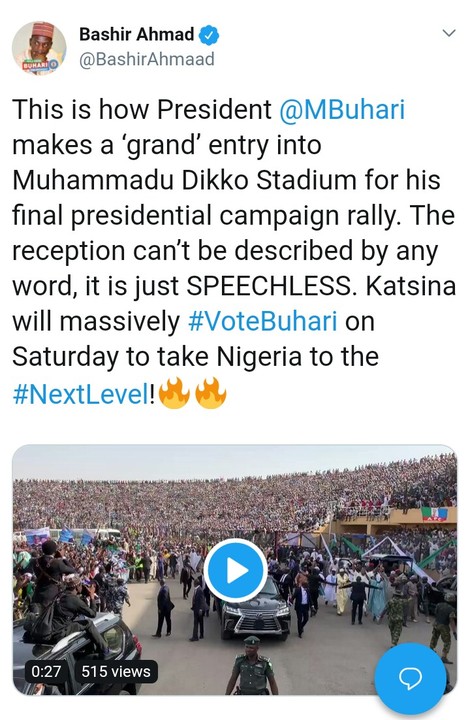
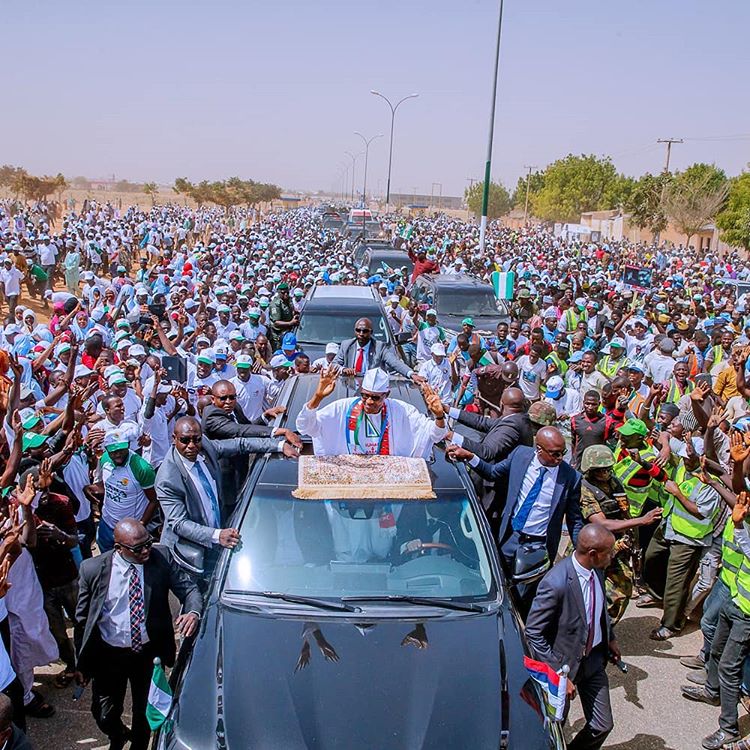
The Moment Buhari Arrived Dikko Stadium In Katsina For His Final Campaign
This is inside Muhammadu Dikko Stadium, Katsina, the venue for APC Presidential Campaign Rally.
Buhari arrive in style at the stadium as mammoth crowd cheer him up. Never seen something like this, President Muhammadu Buhari is purely loved by majority of people.
As shared by Bashir Ahmad he wrote :
This is how President Muhammadu Buhari makes a ‘grand’ entry into Muhammadu Dikko Stadium for his final presidential campaign rally. The reception can’t be described by any word, it is just SPEECHLESS.http://www.thenaijafame.com.ng/2019/02/swag-stunning-and-massive-here-is.html?m=1

Buhari arrive in style at the stadium as mammoth crowd cheer him up. Never seen something like this, President Muhammadu Buhari is purely loved by majority of people.
As shared by Bashir Ahmad he wrote :
This is how President Muhammadu Buhari makes a ‘grand’ entry into Muhammadu Dikko Stadium for his final presidential campaign rally. The reception can’t be described by any word, it is just SPEECHLESS.http://www.thenaijafame.com.ng/2019/02/swag-stunning-and-massive-here-is.html?m=1
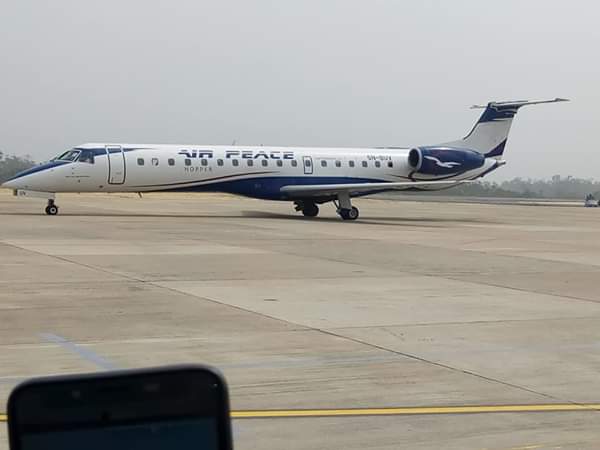
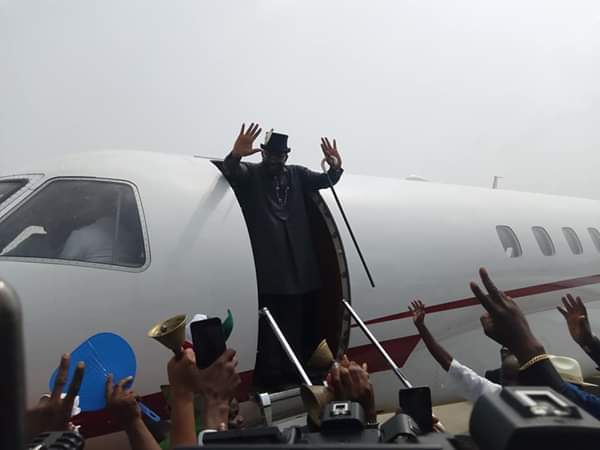
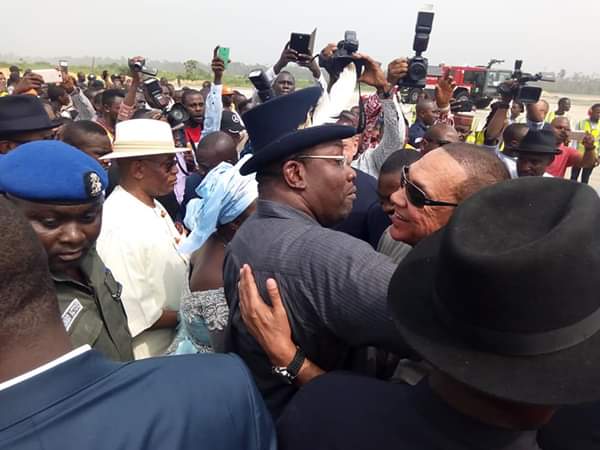
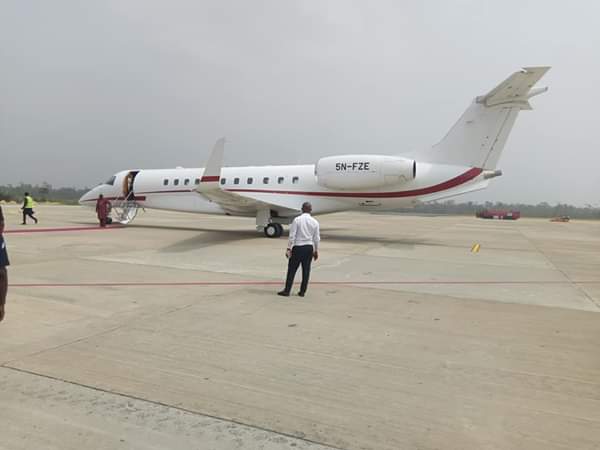
First Flight Lands At Bayelsa International Airport Built By Gov. Dickson
Below are photos of the first historic flight to land at Bayelsa International Airport built by Governor Henry Seriake Dickson, Governor of Bayelsa State.He was in the flight when it landed.
http://www.trezzyhelm.com/2019/02/first-flight-lands-at-bayelsa.html


http://www.trezzyhelm.com/2019/02/first-flight-lands-at-bayelsa.html
Taraba Govt Sacks Husband Of Woman Who Died In APC Rally Stampede
Taraba State Government has sacked Alhaji Haruna Kawuwa who is the husband of Safiya who died along with eight others in a stampede during the APC presidential rally in Jalingo last Thursday.
Haruna Kawuwa, before his sack, was Head of Local Government Administration (HOLGA) in Ardo-Kola Local Government Council in the state.
Haruna’s sack was contained in a letter with reference no LGSCSAR/S/vol1334 and dated 13 February 2019. It was signed by the Permanent Secretary Local Government Service Commission, Malam Lawal Yakubu.
The letter, however, did not disclose the offence committed by late Safiya’s husband but it was gathered that Governor Darius gave the order for the sacking of Malam Haruna for allowing his wife to attend an APC rally.
The junior brother of Mr. Abel Peter Diah, Speaker of Taraba State House of Assembly has been appointed to replace Malam Haruna.
Meanwhile, All Progressives Congress (APC) in the state has condemned the sacking of Malam Haruna Kawuwa.
The publicity secretary of the party, Mr Aaron Artimas said the action of the state government was undemocratic and inhumane.
https://www.dailytrust.com.ng/taraba-govt-sacks-husband-of-woman-who-died-in-apc-rally-stampede.html
Monday, 4 February 2019
Atiku Abubakar

Atiku Abubakar GCON (born 25 November 1946) is a Nigerian politician and businessman. He served as the 11th vice-president of Nigeria from 1999 to 2007 under the presidency of Olusegun Obasanjo. He is a member of People's Democratic Party.
In 1998 he was elected Governor of Adamawa State. While still Governor-Elect, he was selected by then presidential candidate Olusegun Obasanjo as his running mate. The duo went on to win elections in February 1999, and Abubakar was sworn-in as Nigeria's second democratically elected vice president on 29 May 1999. Abubakar's second term as Vice President was marked by a stormy relationship with President Obasanjo. His bid to succeed Obasanjo did not receive the latter's support, and it took a judgment of the Supreme Court to allow Abubakar contest after he was initially disqualified by the Independent National Electoral Commission on the grounds that he had been indicted for financial misconduct by an investigating panel set up at Obasanjo's behest. The Supreme Court ordered the electoral commission to restore Abubakar's name onto the presidential ballot. Abubakar ran on the platform of the Action Congress, having quit the PDP on account of his issues with President Obasanjo. Abubakar lost the election, placing third after Umaru Yar'Adua and Muhammadu Buhari of the All Nigeria Peoples Party (ANPP).
Abubakar is a co-founder of Intels, an oil servicing business with extensive operations in Nigeria and abroad. He is also the founder of Adama Beverages Limited, and the American University of Nigeria (AUN), both in Yola, Adamawa.
Early life
Atiku Abubakar was born on November 25, 1946 to a Fulani trader and farmer Garba Abubakar, and his second wife, Aisha Kande, in Jada village of Adamawa State. Atiku Abubakar became the only child of his parents when his only sister died at infancy. Atiku’s father and mother divorced before his father died in 1957 and his mother remarried. Atiku said:
Eventually, his mother died in 1984 of a heart attack. Atiku Abubakar could not start school when he grew old enough to because his father was opposed to him obtaining Western education. When his not going to school was noticed, his father was arrested and jailed until he paid a fine. Consequently, Atiku Abubakar was admitted into Jada Primary School at the age of eight.
After completing primary school, Atiku was admitted into Adamawa Provincial Secondary School, Yola in 1960. He graduated from secondary school in 1965 after he made grade three[definition needed] in the West African School Certificate Examination. Abubakar then proceeded to attend Nigerian Police College, Kaduna. He left the college for a position as a tax official in the Regional Ministry of Finance. Later he received admission to study at the School of Hygiene, Kano in 1966. In 1967, he graduated with a diploma. That same year, Atiku Abubakar was admitted for a Law Diploma at Ahmadu Bello University on a scholarship. He graduated in 1969 and was employed by Nigeria Customs Service that same year.
Education
His father was opposed to the idea of Western education, and tried to keep Atiku Abubakar out of the traditional school system. When the government discovered that Abubakar was not attending mandatory schooling, his father spent a few days in jail until Aisha Kande's mother paid the fine
At the age of eight Abubakar enrolled in the Jada Primary School. He said:
In 1960, he was admitted to Adamawa Provincial Secondary School in Yola where he did well in English Language and Literature, struggled with Physics and Chemistry and Mathematics. He graduated with a Grade Three WASSCE/GCE Certificate in 1965.
Following secondary school, Abubakar studied a short while at the Nigeria Police College in Kaduna . He left the College when he was unable to present an O-Level Mathematics result.He worked briefly as a Tax Officer in the regional Ministry of Finance, from where he gained admission to the school of Hygiene in Kano in 1966. He graduated with a Diploma in 1967, having served as Interim Student Union President at the school. In 1967 he enrolled for a Law Diploma at the Ahmadu Bello University Institute of Administration, on a scholarship from regional government. After graduation in 1969, during the Nigerian Civil War, he was employed by the Nigeria Customs Service.
Marriages and family
Abubakar has four wives and is the father of 28 children.
While at Idi-Iroko, Abubakar met nineteen-year-old Titilayo Albert, who he secretly married in December 1971, in Lagos, because her family was initially opposed to the union. On 26 October 1972, Titilayo delivered a baby girl they named Fatima. She later gave birth to Adamu, Halima and Aminu.
In January 1979, he married Ladi Yakubu as his second wife. "I wanted to expand the Abubakar family. I felt extremely lonely as a child. I had no brother and no sister. I did not want my children to be as lonely as I was. This is why I married more than one wife. My wives are my sisters, my friends, and my advisers and they complement one another," Abubakar has said. He has six children with Ladi: Abba, Atiku, Zainab, Ummi-Hauwa, Maryam and Rukaiyatu.
In 1983 he married his third wife, Princess Rukaiyatu, daughter of the late Lamido of Adamawa, Aliyu Musdafa. She gave birth to Aisha, Hadiza, Aliyu (named after her late father), Asmau, Mustafa, Laila and Abdulsalam. His fourth wife, Fatima Shettima, followed in 1986. Fatima gave birth to her first child Amina (Meena), Mohammed and two sets of twins Ahmed and Shehu, Zainab and Aisha then her last daughter Hafsat.
Abubakar later divorced Ladi, allowing him to marry, as his fourth wife (the maximum permitted him as a Muslim), Jennifer.
Business career
Abubakar started out in the real estate business during his early days as a Customs Officer. In 1974 he applied for and received a 31,000 naira loan to build his first house in Yola, which he put up for rent. From proceeds of the rent he purchased another plot, and built a second house. He continued this way, building a sizeable portfolio of property in Yola.
In 1981 he moved into agriculture, acquiring 2,500 hectares of land near Yola to start a maize and cotton farm. The business fell on hard times and closed in 1986. "My first foray into agriculture, in the 1980s, ended in failure," he wrote in an April 2014 blog. He then ventured into trading, buying and selling truckloads of rice, flour and sugar.
Abubakar worked in the Nigeria Customs Service for twenty years, rising to become the Deputy Director, as the second highest position in the Service was then known. He retired in April 1989 and took up full-time business and politics. He ran for the office of governor in the Gongola State (now Adamawa and Taraba States) in 1991, and for the Presidency in 1993, placing third after MKO Abiola and Babagana Kingibe in the Social Democratic Party (SDP) primaries.
Abubakar's most important business move came while he was a Customs Officer at the Apapa Ports. Gabrielle Volpi, an Italian businessman in Nigeria, invited him to set up Nigeria Container Services (NICOTES), a logistics company operating within the Ports. NICOTES would go on to provide immense wealth to Abubakar. Conflict of interest accusations have since trailed him on account of his involvement in business while a civil servant, who exercised supervisory authority.
On his part, Abubakar has defended the decision, saying his involvement was limited to the ownership of shares (which government rules permitted), and that he was not involved in the day-to-day running of the business. NICOTES would later be rebranded INTELS, and go on to feature prominently in accusations of money laundering levelled against Abubakar by the U.S. government during his Vice Presidency.
Abubakar's business empire also includes a beverage manufacturing plant in Yola, as well as an animal feed factory.
Early political career
Abubakar's first foray into politics was in the early 1980s, when he worked behind-the-scenes on the governorship campaign of Bamanga Tukur, who at that time was managing director of the Nigeria Ports Authority. He canvassed for votes on behalf of Tukur, and also donated to the campaign. Towards the end of his Customs career, he met Shehu Musa Yar'Adua, who had been second-in-command of the military government that ruled Nigeria between 1976 and 1979. Abubakar was drawn by Yar'Adua into the political meetings that were now happening regularly in Yar'Adua's Lagos home. In 1989 Abubakar was elected a National Vice-Chairman of the Peoples Front of Nigeria, the political association led by Yar'Adua, to participate in the transition programme initiated by Head of State Ibrahim Babangida. The Peoples Front of Nigeria included politicians such as Umaru Musa Yar'Adua, Babalola Borishade, Bola Tinubu, Abdullahi Aliyu Sumaila, Rabiu Kwankwaso and Sabo Bakin Zuwo.
Abubakar won a seat to represent his constituency at the 1989 Constituent Assembly, set up to decide a new constitution for Nigeria. The People's Front was eventually denied registration by the government (none of the groups that applied was registered), and found a place within the Social Democratic Party, one of the two parties decreed into existence by the regime.
First gubernatorial run
On 1 September 1990, Abubakar announced his Gongola State gubernatorial bid. A year later, before the elections could hold, Gongola State was broken up into two – Adamawa and Taraba States – by the Federal Government. Abubakar fell into the new Adamawa State. After the contest he won the SDP Primaries in November 1991, but was soon disqualified by government from contesting the elections.
First presidential run
A similar fate – disqualification by the military – would befall Shehu Musa Yar'Adua, Abubakar's friend and political mentor, in his 1992 bid for the presidential primary of the SDP. With no chance of contesting for the presidency, Yar'Adua decided to push Abubakar forward as the focal point of SDP's ambitions. Abubakar came third in the convention primary. But because MKO Abiola, the winner, had won by only about 400 votes a run-off was due. Abubakar stepped down for Abiola, asking his supporters to cast their votes for him, with an unwritten agreement that Abiola would announce Abubakar as his running mate. Abiola won the SDP ticket, and announced Babagana Kingibe, the runner-up, as his running mate.
Second gubernatorial run
In 1998 Abubakar launched a bid for the governorship of Adamawa State on the platform of the People's Democratic Party. He won the December 1998 elections, but before he could be sworn in he was tapped by the PDP's presidential candidate, former Head of State Olusegun Obasanjo, as his vice-presidential candidate. The Obasanjo-Abubakar ticket won the 27 February 1999 presidential election with 62.78 percent of the vote.
Vice-Presidency

Abubakar was sworn in as Vice-President of Nigeria on 29 May 1999. He presided over the National Council on Privatization, overseeing the sale of hundreds of loss-making and poorly managed public enterprises.
In 1999 he, alongside South African Deputy President Jacob Zuma, launched the South Africa Nigeria Binational Commission.
In 2006, Abubakar was involved in a bitter public battle with his boss, President Olusegun Obasanjo, ostensibly arising from the latter's bid to amend certain provisions of the constitution to take another shot at the presidency (for the third consecutive time).
In a November 2013 interview Abubakar is quoted as saying, regarding Obasanjo's alleged attempts to justify his third term bid: "[He] informed me that 'I left power twenty years ago, I left Mubarak in office, I left Mugabe in office, I left Eyadema in office, I left Umar Bongo, and even Paul Biya and I came back and they are still in power; and I just did eight years and you are asking me to go; why?' And I responded to him by telling him that Nigeria is not Libya, not Egypt, not Cameroun, and not Togo; I said you must leave; even if it means both of us lose out, but you cannot stay."
The debate and acrimony generated by the failed constitutional amendment momentarily caused a rift in the People's Democratic Party. The Nigerian National Assembly eventually voted against any amendments allowing Obasanjo to run for another term.
The Abubakar-Obasanjo face-off damaged the personal relationship between both men.
Second presidential run
On 25 November 2006 Abubakar announced that he would run for president. On 20 December 2006, he was chosen as the presidential candidate of the Action Congress (AC).
On 14 March 2007, the Independent National Electoral Commission (INEC) released the final list of 24 aspirants for 21 April presidential election. Abubakar's name was missing from the ballot. INEC issued a statement stating that Abubakar's name was missing because he was on a list of persons indicted for corruption by a panel set up by the government. Abubakar headed to the courts on 16 March to have his disqualification overturned.

The Supreme Court unanimously ruled on 16 April that INEC had no power to disqualify candidates.
The ruling allowed Abubakar to contest the election, although there were concerns that it might not be possible to provide ballots with Abubakar's name by 21 April, the date of the election. On 17 April, a spokesman for INEC said that Abubakar would be on the ballot.
According to official results, Abubakar took third place, behind PDP candidate Umaru Yar'Adua and ANPP candidate Muhammadu Buhari, with approximately 7% of the vote (2.6 million votes). Abubakar rejected the election results and called for its cancellation, describing it as Nigeria's "worst election ever."
He stated that he would not attend Umaru Yar'Adua's inauguration on 29 May due to his view that the election was not credible, saying that he did not want to "dignify such a hollow ritual with my presence."
Post Vice-Presidency
Third presidential run
Following the 2007 elections, Abubakar returned to the People's Democratic Party. In October 2010 he announced his intention to contest for the Presidency. On 22 November, a Committee of Northern Elders selected him as the Northern Consensus Candidate, over former Military President Ibrahim Babangida, former National Security Adviser Aliyu Gusau and Governor Bukola Saraki of Kwara State.
In January 2011, Abubakar contested for the Presidential ticket of his party alongside President Jonathan and Sarah Jubril, and lost the primary, garnering 805 votes to President Jonathan's 2736.
Relationship with President Obasanjo
On 30 March 2014, Nigerian media reported that a delegation from the Northern Youth Leaders Forum visited Obasanjo at his home in Abeokuta and pleaded with him to "forgive your former vice-president, Alhaji Atiku Abubakar of whatever political sin or offence he might have committed against you." In response Obasanjo is quoted as saying that "as a leader and father, I bear no grudge against anybody and if there is, I have forgiven them all."
Peoples Democratic Movement (PDM)
In August 2013, the Independent National Electoral Commission (INEC) registered two new political parties. One of them was the Peoples Democratic Movement. Local media reports suggested that the party was formed by Abubakar as a back-up plan in case he was unable to fulfill his rumoured presidential ambitions on the PDP platform. In a statement Abubakar acknowledged that the PDM was founded by his "political associates", but that he remained a member of the PDP.
All Progressives Congress
On 2 February 2014, Abubakar left the Peoples Democratic Party to the join All Progressives Congress. with the intent of contesting the Nigerian presidency in 2015 on the party's platform.
On Friday, 24 November 2017, Abubakar announced his exit from the All Progressives Congress (APC), a party he helped to form.
Return to PDP
On December 3, 2017, via a Facebook Live broadcast, Abubakar announced his return to the Peoples Democratic Party (PDP). The announcement followed consultations the former Vice President had with party leaders and stakeholders from across the country. He said he decided to 'return home' to the PDP now that the issues which made him leave the party had been resolved.
Fourth presidential run
Abubakar declared his candidacy for the presidential nomination of the PDP mid 2018 and won the nomination at its convention on October 7. He defeated 11 other contestants and got 1,532 votes, 839 more than the runner-up, the Governor of Sokoto State Aminu Tambuwal.
Atiku Abubakar continued his campaign rally in Kogi State as he promise to complete abandoned projects in the state.
Philanthropy and promotion of education
American University of Nigeria (AUN) is the first American-style university to be established in Sub-Saharan Africa. It was founded in Yola, the capital of Adamawa State as American University of Nigeria (AUN) by Abubakar in 2005. He has said that having benefited from the U.S. system of instruction as a young man, he was eager to make available in Nigeria an American trained faculty – emphasising critical thinking, small classes, student participation, problem-solving. AUN has received special recognition from Google.
In 2012 Abubakar donated $750,000 to the National Peace Corps Association in the United States, "to fund a new initiative featuring global leaders who will discuss Peace Corps's impact." It was the largest ever individual donation in the Association's history.
In his speeches and commentary Abubakar is a vocal advocate of the importance of Nigeria's educational system. In August 2013 he sponsored a students' essay contest to generate solutions to Nigeria's most pressing institutional educational challenges. Entrants were asked to write between 2,000 and 5,000 words on the topic 'More Learning to More People: How can Nigeria be more innovative in bridging its literacy and skills gap?'.
A longlist was announced on 21 October 2013, and the winners a week later. The joint first prize went to Kenechukwu Nneka Lily Nwagbo and Emeka Chigozie Ezekwesiri.
Upon the release of the dismal results of the May–June 2014 West African Examinations Council (WAEC) results, Abubakar said, in a statement:
″Our country’s educational institutions are clearly not providing quality learning. Our teachers need to be taught. This situation is a new development—of the past 10 years or so. The steady decline of education in Nigeria is a reflection of our country’s relegation of education to the background of national essentialities. That is where the change must begin. Teachers are important—as important as senators and doctors. Indeed, teachers determine the quality of senators and doctors. And so, the entire country stands to suffer the effects of this neglect in future. Nigeria must once again make education a priority. We must return to the basics.″
In a bid to alleviate the educational decadence in Northeastern Nigeria, Abubakar issued scholarship to 15 escapees of the Chibok schoolgirls kidnapping.
Jefferson William bribery and money laundering case in the United States
Abubakar is banned from travelling to the United States for a reason unknown to the public. Atiku was implicated in an international bribery scandal along with William Jefferson and one of Atiku's wives, Jenifer Atiku Abubakar. In January 2017, the U.S. government released a statement saying it would need the consent of the politician before it can disclose the true state of his immigration status to the United States. Abubakar has publicly claimed that the true reason is that his visa is still being processed, a statement the spokesperson for the Nigerian president called "curious".
However, In recent times, Atiku in company with Bukola Saraki visited the United States January 17, 2019 with the aid of Brian Ballard.
Honours and awards
In 1982 Abubakar was awarded the chieftaincy of the Turaki of Adamawa by Adamawa's traditional ruler, Alhaji Aliyu Mustafa. The title had previously been reserved for the monarch's favourite prince in the palace, as the holder is in charge of the monarch's domestic affairs.
In 2011, while celebrating the 50th anniversary of the US Peace Corps in 2011, the National Peace Corps Association (NPCA) – an independent 501 (c) (3) nonprofit organisation, separate from the Peace Corps, that serves as an alumni association for Returned Peace Corps Volunteers – honoured Abubakar with the Harris Wofford Global Citizen Award.
At the presentation of the award, the National Peace Corps Association described Abubakar as one individual who contributed to the development of higher education on the continent of Africa. "No private businessman in Africa has worked harder for democracy or contributed more to the progress of higher education than Atiku Abubakar," the NPCA said.
At the presentation of the award, the National Peace Corps Association described Abubakar as one individual who contributed to the development of higher education on the continent of Africa. "No private businessman in Africa has worked harder for democracy or contributed more to the progress of higher education than Atiku Abubakar," the NPCA said.
In June 2017, Abubakar was awarded the chieftaincy title of the Waziri of Adamawa, and his previous title of Turaki was transferred to his son Aliyu.
Social media
Abubakar has been active on Twitter since the 2011 elections, but stepped up his engagement in May 2013. In August 2013, he became the only second Nigerian politician to be verified, after Lagos State Governor Tunde Fashola. As at November 2015, he had more than 390,000 followers. He currently has 450,000 Facebook fans. Also in 2013, he launched a blog.
In an August 2013 post, he shared his views on the role and relevance of social media to governance and democracy in Nigeria.
True Federalism campaign
Abubakar launched the True Federalism campaign in 2017. He has been delivering speeches all over the country inspiring Nigerians on the need to restructure the country. He has been receiving massive endorsement for his stand on True Federalism.
He recently declared at an event where he was conferred the award Hero Of Democracy by Hall of Grace Magazine.
“Political decentralization will also help to deepen and strengthen our democracy as it will encourage more accountability. Citizens are more likely to demand accountability when governments spend their tax money rather than rent collected from an impersonal source.”
He also said: "True Federalism will encourage states to competes to attract investments and skilled workers rather than merely waiting for monthly revenue allocation from Abuja"
Many of his speeches have caused positive stir nationwide as Nigerians are supporting the idea of True Federalism which involves allowing states to have control over their resources most especially the South South and South East of Nigeria.
Subscribe to:
Posts (Atom)
MEET OUR PRINCIPAL PARTNER
AKAAWASE MARTINS, the Associate Executive at Blimp Consults Nigeria, owners of Blimp Shelter and Spatel plan. An alumnus of The Nigerian Arm...

-
 If you live in Benue State, then you most likely want to register and write your exams within your state. After all there are several a...
-
Federal Government College Vandeikya school anthem.